Hotels, resorts, and restaurants manage many moving parts every day. Teams process orders, update reservations, prepare rooms, monitor inventory, handle guest billing, record expenses, and prepare management reports.
When these activities are handled through disconnected systems, employees may need to encode the same information several times. Reports can arrive late, departments may work with different figures, and managers may struggle to see what is happening across the business.
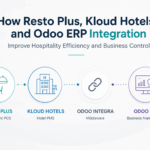
Connecting Resto Plus, KloudHotels, and Odoo ERP through Odoo Integra can create a more coordinated hospitality technology environment.
Instead of treating restaurant sales, hotel operations, inventory, accounting, and reporting as separate activities, integration helps relevant information move between systems. This can improve operational efficiency while giving management better visibility and control.
What Does Hospitality System Integration Mean?
Hospitality system integration means connecting different software platforms so they can exchange relevant operational information.
Each system continues to perform its specialized role:
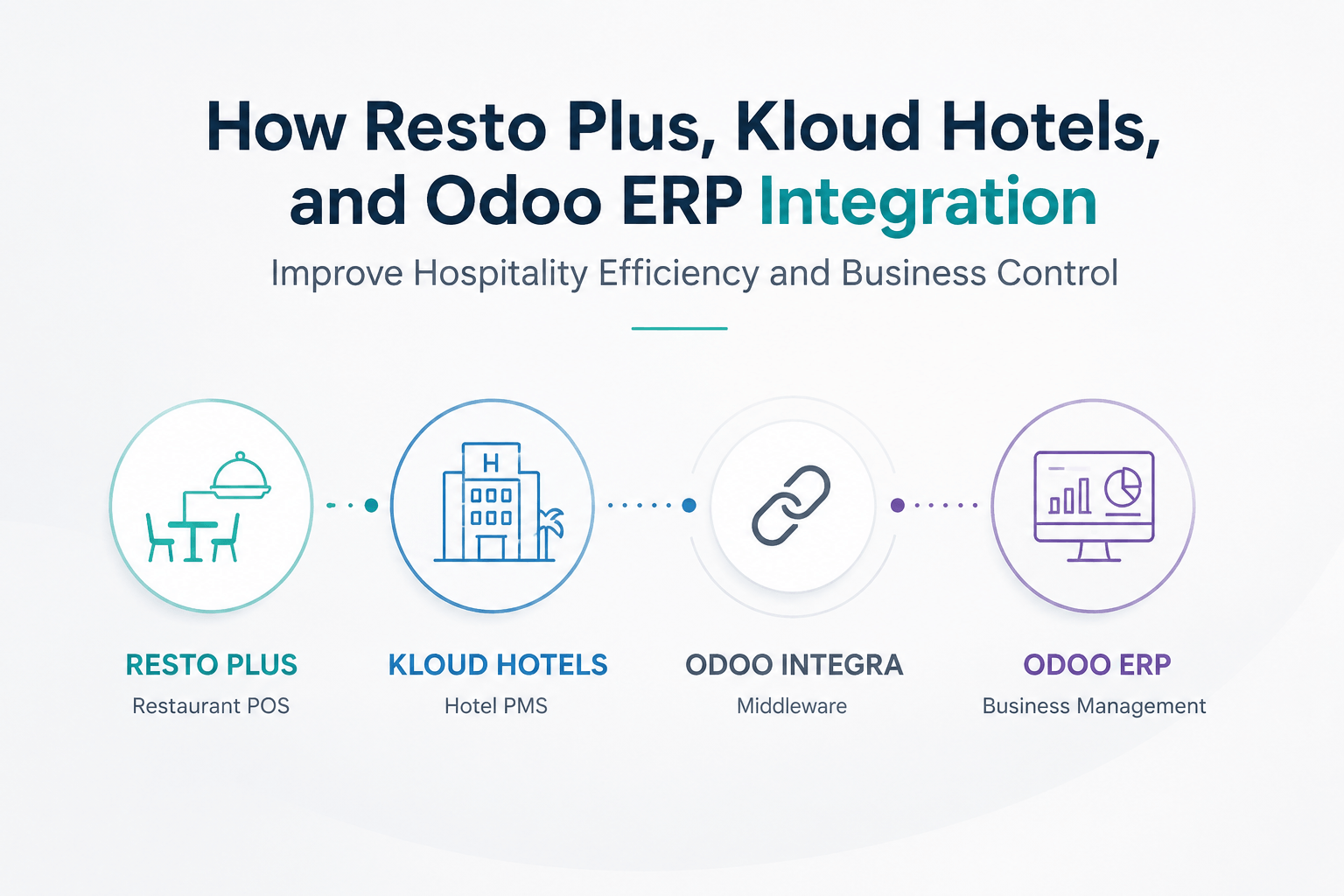
- Resto Plus supports restaurant point-of-sale and food-and-beverage workflows.
- KloudHotels supports hotel reservations, guest transactions, room operations, and front-office processes.
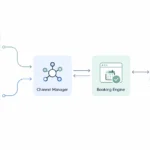
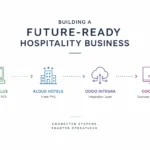
- Odoo Integra acts as the connection layer between operational systems and the ERP.
- Odoo ERP supports broader business functions such as accounting, inventory, purchasing, sales, human resources, and management reporting.
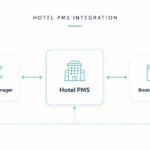
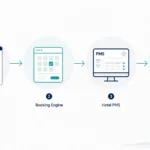
A simplified data flow may look like this:
Restaurant transactions → Resto Plus → Odoo ERP → Odoo ERP
Hotel transactions → KloudHotels → Odoo Integra → Odoo ERP
This connection helps reduce the need to manually move information from one system to another.
Why Disconnected Hospitality Systems Create Operational Problems
A hotel or restaurant may have capable software but still experience inefficient workflows when its systems do not communicate.
For example, restaurant sales may be recorded in the POS but transferred manually to accounting. Hotel transactions may be available in the property management system but require separate reconciliation before management can review consolidated figures.
These disconnected processes can lead to:
- Duplicate data entry
- Inconsistent records
- Delayed financial reporting
- Limited inventory visibility
- Reconciliation difficulties
- Slower management decisions
- Poor coordination between departments
- Challenges when managing multiple branches or properties
The problem is not always the individual software. It is often the absence of a reliable connection between operational and back-office systems.
How Resto Plus Supports Restaurant Efficiency
Resto Plus is designed to support restaurant and food-and-beverage operations.
Depending on the selected configuration, it can assist with areas such as:
- Order processing
- Cashiering and billing
- Table management
- Restaurant sales reporting
- Local discount handling
- Hold-and-fire workflows
- Tablet-assisted order taking
- Coordination with hotel and back-office processes
For restaurant teams, an organized POS workflow can make it easier to process orders, record transactions, and monitor daily activity.
However, the value increases when restaurant data can also support inventory, accounting, purchasing, and management reporting.
Through integration, relevant restaurant transactions can be transferred to a broader business management environment. This reduces the need for finance or administrative teams to recreate information already recorded at the point of sale.
How KloudHotels Improves Hotel Operations
KloudHotels is a cloud-based property management system designed to support hotel and resort operations.
It can help manage areas such as:
- Room reservations
- Guest information
- Check-in and check-out
- Room assignments
- Guest billing
- Housekeeping coordination
- Room-status monitoring
- Front-office workflows
- Operational reports
A property management system gives hotel teams a central environment for handling guest-related and room-related activities.
When KloudHotels is connected with Odoo ERP through Odoo Integra, relevant hotel information can contribute to broader financial and management processes.
This gives department heads and business owners a clearer view of how front-office activity connects with back-office performance.
The Role of Odoo Integra
Odoo Integra functions as middleware between hospitality systems and Odoo ERP.
Middleware is a software layer that allows separate applications to exchange information. It helps translate, organize, and transfer data according to the business’s integration requirements.
Without middleware, employees may need to:
- Export information from one system.
- Review or reformat it manually.
- Enter it into another platform.
- Check whether the figures match.
- Repeat the process for every reporting period.
Odoo Integra can help streamline this flow by connecting relevant data from Resto Plus and KloudHotels with Odoo ERP.
The exact information exchanged depends on the agreed system configuration, business workflows, and implementation scope.
How Odoo ERP Strengthens Business Control
Odoo ERP provides a broader platform for managing connected business functions.
Depending on the modules implemented, hospitality businesses may use Odoo for:
- Accounting and finance
- Purchasing
- Inventory management
- Sales
- Customer relationship management
- Human resources
- Expense monitoring
- Business reporting
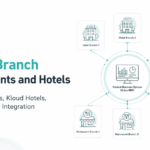
- Multi-branch management
The ERP becomes the wider business environment where information from different operational areas can be organized and reviewed.
For management, this can provide better control over questions such as:
- How are individual branches performing?
- Are sales figures aligned with accounting records?
- What inventory items need replenishment?
- Where are operational costs increasing?
- Which departments require closer attention?
- Are management reports based on current information?
Instead of gathering data from multiple disconnected sources, decision-makers can work toward a more consolidated view of the business.
Key Efficiency Benefits of an Integrated Hospitality System
1. Reduced Repetitive Data Entry
When systems exchange information, employees spend less time transferring the same data manually.
This helps administrative and finance teams focus on reviewing information rather than repeatedly encoding it.
It can also reduce the risk of typing errors, missing entries, and inconsistent records.
2. Faster Reporting
Disconnected systems often require managers to wait while teams collect and combine information.
An integrated environment can make relevant data available more efficiently, helping reports reflect operational activity sooner.
Faster access does not automatically guarantee better decisions, but it gives managers more timely information to evaluate.
3. Better Coordination Between Departments
Restaurant, front-office, finance, inventory, and management teams may use different applications.
Integration helps create a clearer flow of information between these areas.
For example, restaurant transactions recorded through Resto Plus can support back-office processes, while hotel activity from KloudHotels can contribute to broader financial reporting.
4. More Consistent Business Information
When teams maintain separate spreadsheets and manually prepared reports, they may work with different versions of the same information.
A connected system helps create a more consistent operational record.
This can improve communication during management meetings, financial reviews, inventory checks, and branch-performance evaluations.
5. Greater Operational Visibility
Business control depends on visibility.
Managers need to understand what is happening across rooms, restaurants, inventory, purchasing, accounting, and other departments.
Integration can bring important information into a more coordinated environment, making it easier to identify patterns, bottlenecks, and areas requiring action.
Improving Inventory and Purchasing Control
Hospitality businesses manage many types of inventory, including:
- Food ingredients
- Beverages
- Guest supplies
- Cleaning materials
- Operating equipment
- Office supplies
- Maintenance items
When sales, inventory, and purchasing information are disconnected, businesses may experience stock shortages, excess ordering, unclear usage patterns, or difficult reconciliation.
Connecting operational systems with ERP processes can support better inventory visibility.
For example, restaurant activity can contribute to the information used by inventory and purchasing teams. Managers can then review stock movement alongside sales and operational requirements.
The final workflow depends on the approved configuration and the data that the business chooses to integrate.
Supporting Better Financial Management
Hospitality finance teams often consolidate information from several departments.
Restaurant sales, room revenue, expenses, purchases, inventory movements, and customer transactions may originate from separate systems.
Manual consolidation takes time and may delay financial reporting.
Integration can help relevant operational information reach the accounting environment more efficiently. This supports:
- Easier transaction review
- More organized reconciliation
- Improved consistency between operational and financial records
- Better visibility into branch or departmental activity
- More timely preparation of management reports
The purpose is not to remove financial controls. It is to reduce avoidable manual work while maintaining proper review and approval processes.
Strengthening the Guest Experience Through Better Operations
Guests may never see the systems used by a hotel or restaurant, but they experience the results of internal workflows.
Operational problems can appear as:
- Slow order processing
- Billing discrepancies
- Delayed room preparation
- Poor coordination between departments
- Repeated requests for the same information
- Inconsistent service
Connected systems can help employees access more consistent information and coordinate tasks more effectively.
Technology alone does not create excellent service. Staff training, leadership, and clear procedures remain essential. However, better-connected systems can give teams a stronger operational foundation for serving guests.
Improving Business Control Across Multiple Departments
Business control means having reliable processes, clear responsibilities, and access to information needed for decision-making.
Integrating Resto Plus, KloudHotels, Odoo Integra, and Odoo ERP can support control by helping management:
- Review restaurant and hotel activity
- Monitor operational and financial information
- Compare departments or locations
- Identify unusual transactions or inconsistencies
- Improve reporting workflows
- Standardize processes
- Prepare for expansion
For hospitality groups, this becomes increasingly important as the organization adds new outlets, properties, or services.
Preparing for Multi-Branch Growth
A workflow that works for one location may become difficult to manage across several branches.
Each additional restaurant outlet or hotel property creates more transactions, users, reports, approval processes, and inventory requirements.
Without standardization, branches may adopt different procedures and reporting formats.
An integrated system can help businesses establish more consistent processes before expansion. This may support:
- Standardized data structures
- Centralized management reporting
- Shared approval workflows
- Clearer branch comparisons
- Better coordination between local teams and head office
- Easier addition of new operating locations
This creates a useful foundation for the next stage of the Jinisys hospitality integration series: managing multi-branch hotels and restaurants.
Important Considerations Before Integration
Successful integration begins with operational planning—not software installation alone.
Hospitality businesses should evaluate:
Current Workflows
Document how restaurant sales, hotel transactions, accounting, inventory, and reporting are currently handled.
Required Data Flows
Determine which information needs to move between Resto Plus, KloudHotels, Odoo Integra, and Odoo ERP.
Not every field must be shared. The integration should focus on data that supports real operational and management requirements.
Data Quality
Review product records, account classifications, branch details, guest information, and other important data before migration or synchronization.
User Responsibilities
Define which employees will use each system, who will approve transactions, and who will review exceptions.
Training Requirements
Provide role-based training so employees understand both the software and the updated workflow.
Support and Optimization
Continue reviewing the integration after implementation. Business requirements may change as the organization grows or introduces new services.
How Jinisys Software Supports Hospitality Integration
Jinisys Software helps Philippine hospitality businesses evaluate and connect operational technologies based on their actual requirements.
Its hospitality and business solutions include Resto Plus, KloudHotels, Odoo Integra, and Odoo ERP implementation.
Rather than treating each application as an isolated product, Jinisys can help businesses review:
- Existing workflows
- Integration requirements
- System configuration
- Data preparation
- Implementation planning
- User training
- Post-implementation support
This consultative approach is important because every hotel, resort, and restaurant has different operating structures, reporting requirements, and growth plans.
A More Connected Approach to Hospitality Management
Improving hospitality efficiency is not simply about making employees work faster.
It is about reducing unnecessary manual tasks, making information more consistent, strengthening coordination, and helping management understand the business more clearly.
By connecting Resto Plus, KloudHotels, Odoo Integra, and Odoo ERP, Philippine hospitality businesses can build a more coordinated operational environment.
Each system continues to serve its specialized purpose, while integration helps relevant information move across restaurant, hotel, and back-office functions.
The result is a stronger foundation for efficiency, visibility, business control, and future growth.
Continue the Jinisys Hospitality Integration Series
Read the earlier articles:
Phase 2:
From POS and Hotel PMS to ERP: Understanding Resto Plus, Kloud Hotels, Odoo Integra, and Odoo ERP
For more information on how Jinisys Software can help you with How Resto Plus, Kloud Hotels, and Odoo ERP Integration Improve Hospitality Efficiency and Business Control, please contact us at 0917 947 7971, or visit us here:
Our Luzon Office:
602 BSA Twin Towers, Bank Drive, Ortigas Mandaluyong City Philippines
Our Visayas Office:
3/F 101 M.L Quezon St. Villa Aurora, Kasambagan Cebu City Cebu / Region 7 6000, Philippines