Expanding from one hotel or restaurant into several locations creates new opportunities—but it also introduces greater operational complexity.
Every new property, branch, outlet, or food-and-beverage department adds more transactions, employees, inventory requirements, reports, approval processes, and customer interactions. When each location uses separate spreadsheets or disconnected systems, management may struggle to obtain a reliable view of the entire organization.
A multi-branch hospitality management system provides a more coordinated approach.
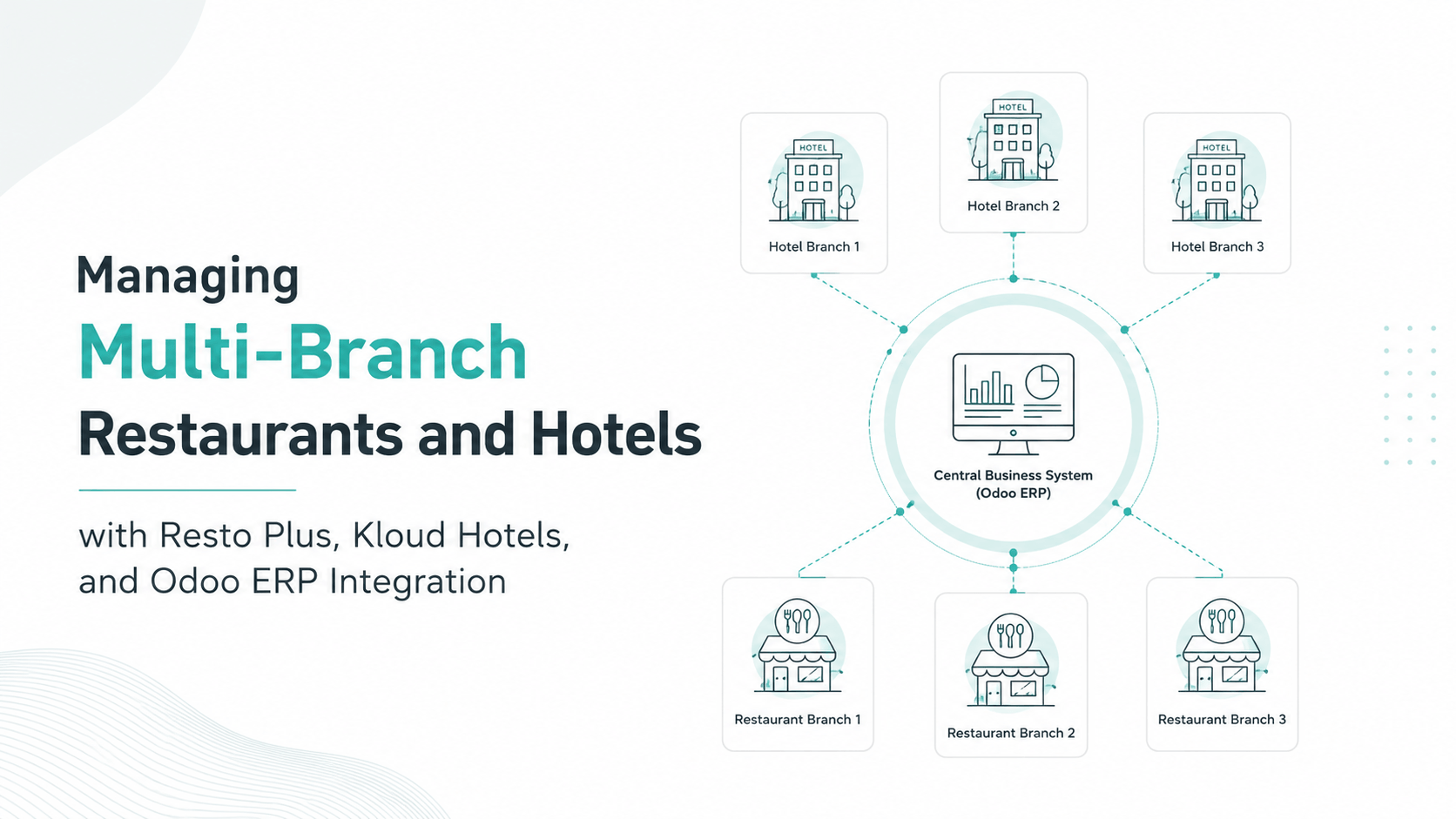
By connecting Resto Plus, KloudHotels, Odoo Integra, and Odoo ERP, hospitality groups can work toward centralized reporting, standardized processes, clearer branch-level visibility, and stronger business control.
What Is a Multi-Branch Hospitality Management System?
A multi-branch hospitality management system connects the operational and back-office tools used across several hotels, resorts, restaurants, or outlets.
Instead of every branch maintaining completely separate processes, the organization establishes a more consistent technology environment.
In the Jinisys ecosystem:
- Resto Plus supports restaurant and food-and-beverage operations.
- KloudHotels supports hotel reservations, guest accounts, room operations, and front-office workflows.
- Odoo Integra serves as the connection layer between hospitality systems and the ERP.
- Odoo ERP supports broader functions such as accounting, inventory, purchasing, sales, human resources, and management reporting.
Each platform continues to serve its specialized role. Integration helps relevant information move across systems and locations according to the agreed implementation scope.
Why Multi-Branch Hospitality Operations Become Difficult to Manage
A single location may be manageable through local reports and direct supervision. As the organization expands, those informal methods become harder to maintain.
Common challenges include:
- Different procedures at every branch
- Separate sales and accounting records
- Delayed submission of branch reports
- Inconsistent product and inventory information
- Difficulty comparing location performance
- Manual consolidation of financial data
- Limited visibility from the head office
- Different approval and purchasing processes
- Repeated data entry
- Difficulty controlling user access
- Inconsistent guest or customer experiences
The problem is not always a lack of software. In many cases, the business already has several applications—but they do not exchange information effectively.
How Resto Plus Supports Multi-Branch Restaurant Operations
Restaurants with multiple outlets need more than fast order processing. They also need consistent workflows, organized reporting, and visibility across locations.
Resto Plus can support food-and-beverage processes such as:
- Order taking
- Point-of-sale transactions
- Cashiering and billing
- Table management
- Sales reporting
- Local discount handling
- Hold-and-fire workflows
- Tablet-assisted order taking
- Hotel and back-office integration
For a multi-branch restaurant group, each outlet may continue handling local transactions while management reviews consolidated or branch-specific information through connected reporting workflows.
This can make it easier to answer questions such as:
- Which outlets are producing the most sales?
- Which locations require closer operational review?
- Are menu items and transaction classifications consistent?
- Are branch reports being submitted using the same structure?
- How do restaurant transactions relate to accounting and inventory records?
The available workflow will depend on the chosen configuration, integrations, and reporting requirements.
How KloudHotels Supports Multiple Hotels and Properties
KloudHotels is a cloud-based property management system that can support hotel and resort operations such as:
- Reservations
- Guest profiles
- Room assignments
- Check-in and check-out
- Guest billing
- Room-status monitoring
- Housekeeping coordination
- Front-office processes
- Operational reporting
For hospitality groups, a consistent PMS environment can help standardize how properties handle reservations, guest transactions, rooms, and front-office activities.
Management can work toward clearer visibility across properties while allowing authorized teams to focus on their assigned hotel or resort.
A centralized approach can be particularly valuable when the business manages:
- Several hotels under one ownership group
- Multiple resorts in different locations
- Boutique properties with a shared head office
- Hotel restaurants and food-and-beverage outlets
- Properties operating under different business entities
How Odoo Integra Connects Branch Operations
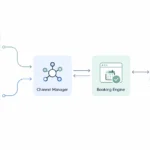
Odoo Integra acts as middleware between hospitality operational systems and Odoo ERP.
Middleware is a software connection layer that allows different applications to exchange selected information.
For a multi-location business, a simplified integration flow may look like this:
Restaurant branches → Resto Plus → Odoo Integra → Odoo ERP
Hotel properties → KloudHotels → Odoo Integra → Odoo ERP
The integration can be designed around the organization’s requirements, including which data should move, how often it should synchronize, and which users can access it.
Not every piece of information needs to be shared. Successful integration focuses on data that supports real operational, financial, and management decisions.
How Odoo ERP Supports Multi-Branch Business Control
Odoo ERP provides a broader environment for managing connected business functions.
Depending on the modules and configuration selected, hospitality groups may use Odoo to support:
- Accounting and finance
- Inventory management
- Purchasing
- Sales
- Customer relationship management
- Expenses
- Human resources
- Approval workflows
- Management reporting
- Multiple companies or business entities
Odoo’s official documentation explains that multiple companies can be configured in one database, with authorized users able to work across selected entities and produce aggregated reports while maintaining company-specific records. The final setup depends on the selected Odoo plan and implementation scope.
For hospitality leaders, this can provide a stronger foundation for reviewing information across branches without relying entirely on separately prepared reports.
Benefits of Integrated Multi-Branch Hospitality Management
1. Centralized Operational Visibility
Managing multiple locations requires a clear view of what is happening across the business.
Connected systems can help management review restaurant, hotel, inventory, financial, and branch-level information within a more coordinated environment.
This makes it easier to identify:
- Locations that require attention
- Differences between branch reports
- Operational bottlenecks
- Unusual sales or inventory activity
- Departments with delayed submissions
- Opportunities to improve processes
Centralized visibility does not remove the need for branch managers. It gives head-office leaders better information for supporting them.
2. Standardized Processes Across Locations
Branches often develop their own methods when procedures are not formally standardized.
One outlet may classify products differently. Another may use a separate reporting format. A hotel may follow different approval procedures from the rest of the group.
Integrated systems can help establish consistent:
- Product and service records
- Transaction classifications
- Reporting structures
- Approval workflows
- User roles
- Branch codes
- Accounting categories
- Inventory procedures
Standardization makes branch comparisons more meaningful and simplifies training when new locations open.
3. Reduced Manual Consolidation
Without integration, head-office employees may need to collect spreadsheets, exports, and reports from every location.
They then review, combine, correct, and reformat the information before management can use it.
A connected environment can reduce this repetitive work by helping operational information move into a shared back-office process.
Employees can spend more time reviewing exceptions and less time rebuilding data that already exists elsewhere.
4. Improved Branch-Level Reporting
A multi-location business needs both consolidated and detailed information.
Management may want a group-wide overview while branch managers need reports for their own location.
An integrated approach can support clearer reporting by:
- Branch
- Property
- Outlet
- Department
- Business entity
- Operational period
- Product or service category
The available reports depend on system configuration, data quality, and the organization’s requirements.
5. Better Inventory and Purchasing Coordination
Hotels and restaurants manage a wide range of stock, including:
- Food ingredients
- Beverages
- Guest supplies
- Cleaning materials
- Maintenance items
- Operating equipment
- Office supplies
When branches purchase independently without centralized visibility, the business may face inconsistent pricing, excess stock, shortages, or unclear usage patterns.
Connecting operational data with inventory and purchasing workflows can help management:
- Review stock movement by location
- Compare purchasing requirements
- Standardize product records
- Monitor replenishment needs
- Identify unusual consumption patterns
- Coordinate selected suppliers and approvals
Technology should support proper inventory controls, not replace physical counting, approvals, or management review.
6. Stronger Financial Oversight
Every branch generates transactions, expenses, purchases, liabilities, and financial reports.
When those records are consolidated manually, reporting can become slower and more difficult to verify.
Connecting hospitality systems with Odoo ERP can support a more organized flow of operational information into accounting and financial reporting processes.
This may help finance teams:
- Review transactions by branch
- Organize reconciliation
- Compare operational and accounting records
- Track expenses more consistently
- Prepare management reports more efficiently
- Maintain clearer records for different entities
Final accounting procedures should still follow the business’s internal controls and applicable Philippine requirements.
7. Easier Expansion to New Locations
Opening a new hotel or restaurant becomes more difficult when the company has no standard operating model.
A connected multi-branch environment can provide reusable structures for:
- User roles
- Product records
- Account classifications
- Reporting templates
- Approval processes
- Inventory categories
- Training materials
- Integration workflows
The company does not need to design every process from the beginning each time it expands.
Improving Guest Experience Across Multiple Locations
Guests expect consistent service, whether they visit the company’s original location or a newly opened branch.
Disconnected operations can affect the guest experience through:
- Slow billing
- Inconsistent service procedures
- Incorrect information
- Delayed room preparation
- Poor communication between departments
- Uneven service quality across properties
Connected systems can help employees work with more consistent information and standardized workflows.
Technology alone cannot guarantee an excellent guest experience. Staff training, leadership, service standards, and clear responsibilities remain essential.
However, the right systems can make it easier for employees to deliver organized and consistent service.
Multi-Branch Restaurant Management Example
Consider a hospitality group operating three restaurants.
Each restaurant processes orders through Resto Plus. Instead of every outlet maintaining separate back-office records, selected transaction data can flow through Odoo Integra into Odoo ERP.
Authorized managers can then work toward reviewing:
- Sales by location
- Branch-level transaction summaries
- Inventory requirements
- Purchasing activities
- Expenses
- Financial reports
The exact data flow must be defined during implementation.
The objective is not merely to centralize everything. It is to centralize the information that helps management operate the group effectively.
Multi-Property Hotel Management Example
Consider a group operating several boutique hotels.
Each property uses KloudHotels for reservations, guest transactions, room status, billing, and front-office operations.
Relevant data can be connected with Odoo ERP through Odoo Integra to support broader financial and management processes.
This can help the organization establish:
- More consistent property reporting
- Standardized operational structures
- Better coordination with head office
- Clearer financial oversight
- A scalable technology model for future properties
Features and integrations should always be confirmed according to the final configuration.
Should Every Branch Use the Same System?
In many cases, standardizing the core platforms provides operational benefits. However, the best setup depends on the organization.
Before deciding, management should review:
- Whether branches follow similar workflows
- Existing software contracts
- Local operating requirements
- Different business entities
- Data-migration requirements
- Hardware compatibility
- Connectivity conditions
- Staff readiness
- Integration complexity
Some businesses may need a phased rollout rather than moving every branch at the same time.
Recommended Multi-Branch Implementation Process
Step 1: Review Every Location
Document how each hotel, restaurant, or outlet currently handles:
- Sales
- Reservations
- Inventory
- Purchasing
- Accounting
- Reporting
- Approvals
- User access
This identifies differences that must be resolved before standardization.
Step 2: Define the Standard Process
Determine which workflows should be consistent across every branch and which must remain location-specific.
Step 3: Establish Data Standards
Create consistent branch codes, product names, account classifications, user roles, and reporting categories.
Step 4: Design the Integration
Define which information should move between Resto Plus, KloudHotels, Odoo Integra, and Odoo ERP.
Step 5: Begin with a Pilot Location
Testing the setup at one selected branch can help the team identify workflow, data, and training issues before a wider rollout.
Step 6: Train Employees by Role
Restaurant staff, front-office teams, finance employees, managers, and administrators require different training.
Step 7: Roll Out in Phases
Introduce the system to additional locations based on operational readiness.
Step 8: Review and Optimize
Monitor data quality, user feedback, reporting requirements, and integration performance after implementation.
Common Multi-Branch Integration Mistakes
Hospitality businesses should avoid:
- Installing software without reviewing workflows
- Migrating inaccurate or duplicated data
- Giving too many users unrestricted access
- Ignoring branch-specific requirements
- Connecting unnecessary information
- Failing to define reporting standards
- Providing insufficient staff training
- Launching every branch without pilot testing
- Treating implementation as a one-time technical task
Successful integration requires operational ownership, employee participation, and ongoing review.
How Jinisys Software Supports Multi-Branch Hospitality Businesses
Jinisys Software helps Philippine hotels, resorts, restaurants, and hospitality groups evaluate integrated technology solutions based on actual operational requirements.
Its ecosystem can include:
- Resto Plus
- KloudHotels
- Odoo Integra
- Odoo ERP implementation
- Hospitality software integration
- Hardware and infrastructure support
- User training
- Post-implementation assistance
Jinisys can help review workflows, design the integration, prepare data, configure systems, train users, and support phased implementation.
This locally informed approach is valuable for businesses that need more than isolated applications.
Building a Scalable Hospitality Operation
Managing several branches requires more than duplicating what worked at the first location.
Businesses need standardized processes, reliable information, appropriate controls, trained employees, and systems capable of supporting expansion.
By connecting Resto Plus, KloudHotels, Odoo Integra, and Odoo ERP, hospitality groups can build a more organized technology environment across restaurants, hotels, departments, and business entities.
The goal is not centralization for its own sake.
The goal is to give each location the tools it needs while giving management the visibility required to guide the entire organization.
Continue the Jinisys Hospitality Integration Series
For more information on how Jinisys Software can help you with Managing Multi-Branch Restaurants and Hotels with Resto Plus, Kloud Hotels, and Odoo ERP Integration, please contact us at 0917 947 7971, or visit us here:
Our Luzon Office:
602 BSA Twin Towers, Bank Drive, Ortigas Mandaluyong City Philippines
Our Visayas Office:
3/F 101 M.L Quezon St. Villa Aurora, Kasambagan Cebu City Cebu / Region 7 6000, Philippines